Quick answer
Grade a men’s activewear range from one approved base size, commonly M or L, with a separate increment for each point of measurement. Chest, waist and hip girths move most, lengths less, neck openings little, and rib and waistband heights usually not at all. Keep each tolerance below half its grade step, then measure a complete size set and fit the smallest, base and largest sizes on real bodies.
The question behind this guide
How should a men’s sportswear size range be graded from S to 5XL?
Buyers often approve one base-size sample and assume the factory’s grading will carry that fit to every size. A grading error is easy to miss at the base size and hard to miss at 5XL, where a uniform increment or a different sizing system has changed ease, length and proportion.
We read the public scope of ISO 8559-1 and ISO 8559-2, ASTM’s adult male and big men body-measurement tables and China’s GB/T 1335.1 sizing standard, then applied them to factory sampling practice. Grade values in the examples are calculation examples, not a published grading standard or a SenLin specification.
Key takeaways
- A size label describes the body it fits; the factory also needs garment measurements, grade rules and a measuring method.
- Girths, lengths and fixed details grade differently; one percentage or one increment for every point distorts 4XL and 5XL.
- Set each tolerance below half the grade step for that point, or neighbouring sizes will overlap.
- Approve the base fit first, then measure every size and fit the extremes, including the first size after a grade break.
What does grading change between sizes?
Grading turns one approved base pattern into a full size range. For every point of measurement (POM), a grade rule states how much that point changes between neighbouring sizes. Stacked together, the graded patterns form a nest, which a pattern maker checks for smooth, evenly spaced lines.
Grading is not enlargement. A percentage scale enlarges everything, including neck openings, rib heights and seam allowances, and adds length at the same rate as width. Real grade rules are set point by point, and many change at a break point, often above XL, where the range moves into big sizes. Applying one fixed increment to every point fails for the same reason.
Which body data should an S–5XL range be built on?
Start from a body chart for your wearers, then add ease to reach garment measurements. ISO 8559-2 sets out size designation based on body dimensions rather than garment measurements, and ISO 8559-1 defines how those body dimensions are taken. On that logic, a tag that says L describes a body, while the factory works to garment measurements. Send both charts, and label which is which.
Published tables show why one body table rarely covers S–5XL. ASTM D6240/D6240M-24a tabulates adult male body measurements for chest sizes 34–52 in short, regular and tall; ASTM D8077/D8077M covers the mature big men figure type in sizes 46–64. Since one chest size appears at three heights, height cannot be inferred from chest, and an unbroken length grade can turn a 5XL tee into a tunic.
Chinese factories may also keep base patterns in national codes. GB/T 1335.1-2008 writes men’s top sizes as height/chest girth plus a body type, such as 175/92A, where A denotes a chest 12–16 cm larger than the waist, and its 5·4 series steps chest girth by 4 cm. Many letter-size charts step the body chest by 8 cm or more per size, so map every factory code to your letter sizes in writing before grading starts.
How should each point of measurement grade?
Use the table to review the grade rules a factory returns. The direction of each rule reflects common practice; the values come from your body chart and intended fit.
HPS is the high point shoulder, where the shoulder seam meets the neckline. Agree how each point is measured, flat or on a form, relaxed or extended, before comparing numbers; a correct grade measured a different way still looks wrong.
| Point of measurement | Typical grade behaviour | Common error |
|---|---|---|
| Chest, waist and hip girth | Largest steps, often bigger above XL | One small step to 5XL, so big sizes lose ease |
| Body length from HPS | Smaller steps, often reduced above XL | Linear length grade makes 5XL too long |
| Armhole depth | Follows chest at a slower rate | Deep armholes lift the hem in an overhead reach |
| Sleeve length | Moderate; measuring point stated | Shoulder-point and centre-back methods mixed |
| Neck width and front drop | Small steps | Graded like chest, so necklines gape |
| Rib, cuff and waistband heights | Usually fixed | Scaled by percentage, so proportions drift |
| Waist, relaxed and extended | Both states graded and recorded | Elastic length not graded with the waist |
| Shorts inseam | Often fixed when the length is marketed | A stated 18 cm inseam grows with each size |
| Logo artwork | Two or three artwork sizes | One size looks lost on 5XL |
How do stretch and compression change the grade?
Stretch changes what the grade must hold constant. A relaxed training tee usually keeps similar positive ease across sizes, so its chest grade tracks the body grade. A base layer or compression short works with negative ease, where the garment is smaller than the body, so the stretch percentage, not the centimetres, should stay consistent.
A garment 10 cm smaller than a 90 cm chest is stretched by 12.5%; the same 10 cm on a 130 cm chest gives under 9%, so large sizes feel looser. Pressure also falls as body radius increases at the same fabric tension, so big-size compression needs fit testing, and sometimes a fabric or construction change, not only a smaller grade.
Elastane content, knit direction and recovery decide how far a grade can rely on stretch. Record the fabric used for the base fit: substituting another fabric later can undo an approved grade even when every measurement is within tolerance.
How tight should grading tolerances be?
Keep each tolerance below half the grade step for that point. If the half chest steps 3 cm between sizes, ±1 cm keeps M and L distinct, ±1.5 cm lets them touch, and ±2 cm allows an oversized M to measure larger than an undersized L. Tolerances therefore belong to individual points, not to the garment as a whole.
Measure after the same preparation every time. If shrinkage is expected, agree whether the chart applies before or after a stated wash and keep that method with the chart; dimensional change itself is tested separately, for example with ISO 5077 using ISO 6330 washing procedures.
SenLin’s published garment tolerance is 1–2 cm for performance tees, long sleeves, shorts, pants and training sets and 1–3 cm for fleece, all in S–5XL; the value for each point is agreed on the approved chart. Standard styles from 100+ pieces use the chart confirmed for that style, while your own chart or grade rules are custom development, from 300–500+ pieces confirmed by style.
Which sizes need a physical fit sample?
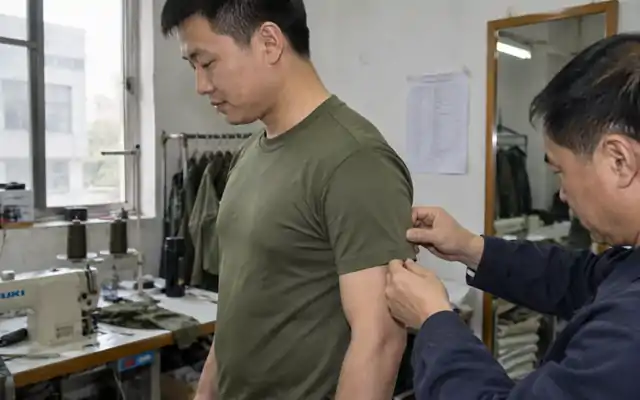
Fit the base size first, then at least the smallest and largest sizes and the first size after any grade break. Approve the base on a fit model whose body matches the base row of your chart, with movement checks that suit the product: a deep squat and lunge for shorts and pants, an overhead reach and torso rotation for tops, and a few minutes of the real activity. Then request a size set, one sample per size or an agreed selection, and measure each piece against the graded chart.
Measurements confirm that the rules were applied; only a body shows whether a 5XL armhole, rise or neckline works. Name who approves changes, record each one against its size and POM, and approve the revised chart before the pre-production sample. A grading brief that leaves the factory nothing to guess contains:
- Body chart for the target wearer, with its data source
- Base-size garment specification, every POM defined and illustrated
- Grade rules per POM, including break points and fixed points
- Tolerance and measuring method per POM, including any wash
- Fabric used for the base fit, with composition and stretch
Continue your buyer research
Connect this decision to the relevant product, factory process and frequently asked questions before requesting a quotation.
Frequently asked questions
What base size should a men’s activewear range use?
Choose a size close to the centre of expected sales, commonly M or L, so the grade runs a similar number of steps each way. If the range reaches 5XL and big sizes matter commercially, some brands develop a second fit block for the extended sizes instead of stretching one block across eight sizes.
Should 3XL to 5XL use the same grade as S to XL?
Not automatically. Many body charts widen the girth interval above XL, while bigger men are not proportionally taller, so girth steps often grow and length steps shrink. Decide the break point from your body data and write it into the grade rules, so the factory does not simply extend the S–XL increments.
Can a factory grade from a reference garment?
It can measure the reference and propose grade rules, but one garment shows only one size of someone else’s fit. If you can, measure the reference in several sizes, because the differences between them reveal its grade. Ask for the proposed base chart and rules in writing, compare them with your body chart and correct them before the size set is made.
Do polos grade differently from performance tees?
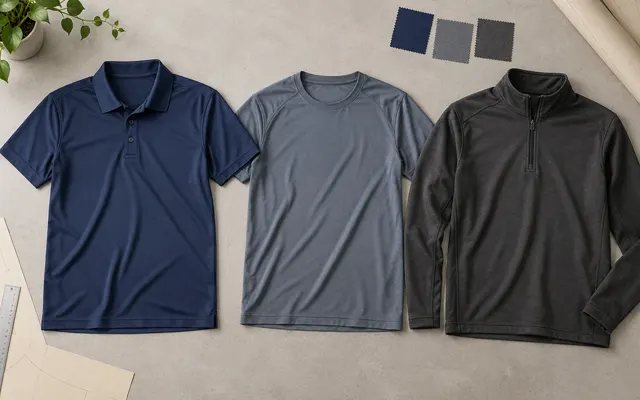
Mostly in the details. Collar length follows the neckline, while placket length, button spacing and collar height are commonly kept fixed or stepped in two or three groups so the front looks consistent. Body and sleeve girths follow the same logic as a tee. SenLin’s performance polos run M–5XL, so their grade starts one size above the S–5XL tee range.
How should matching tops and bottoms be sized?
Grade and label them separately, because many wearers take a different size above and below the waist. If a set is sold as one item, state which top and bottom sizes are paired and how they are packed. If buyers can mix sizes, plan the quantity matrix by top size and bottom size rather than by set, so the factory cuts the right number of each.
Sources and evidence notes
- Standards publisher: public scopeISO: ISO 8559-1 anthropometric definitions for body measurement
- Standards publisher: public scopeISO: ISO 8559-2:2025 size designation by primary and secondary body dimensions
- Standards publisher: public scopeASTM: D6240/D6240M-24a body measurements for adult males, chest sizes 34–52
- Standards publisher: public scopeASTM: D8077/D8077M-16(2022) body measurements for mature big men, sizes 46–64
- Standards publisher: public scopeSAMR and SAC: GB/T 1335.1-2008 standard sizing systems for garments, men