Quick answer
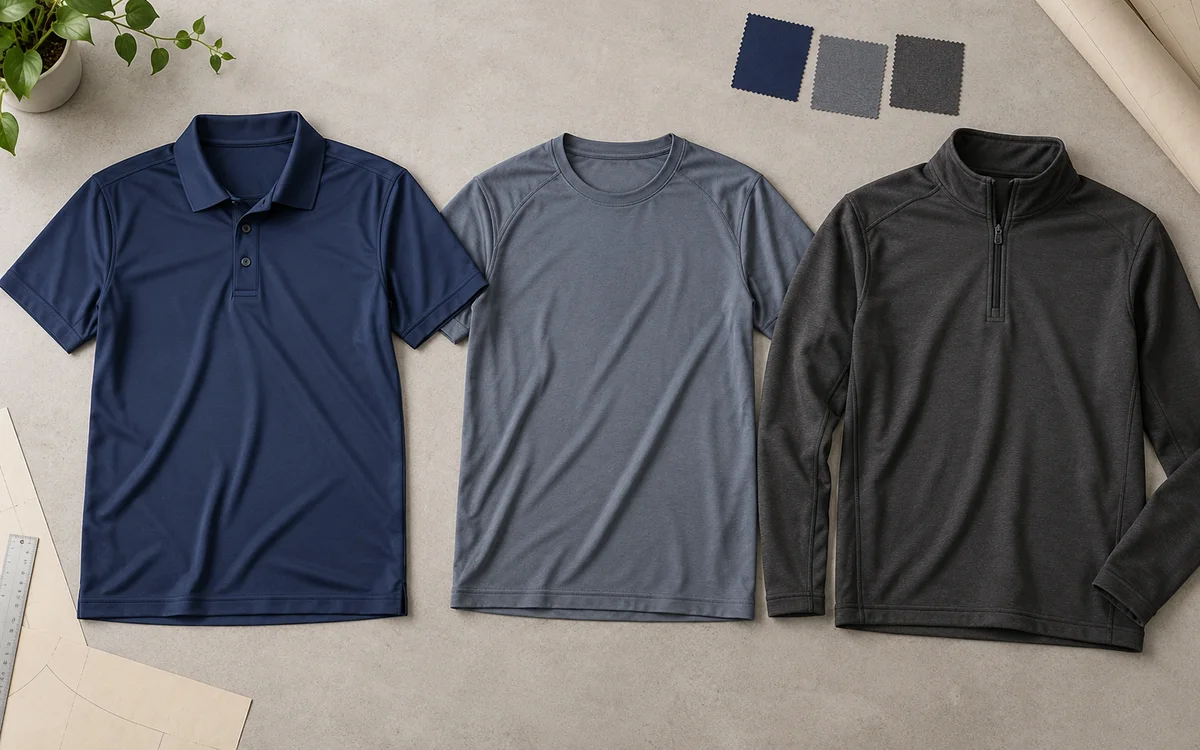
Build a teamwear capsule around three jobs: a performance polo for customer-facing or smart team use, a technical T-shirt for training and active roles, and a lightweight midlayer for cooler conditions. Keep the colours and logo hierarchy consistent, but approve fit, fabric, decoration and care separately for each garment. Start with a role-and-size matrix, then sample the three pieces together before confirming the order.
The question behind this guide
How should a buyer plan a small branded teamwear range without over-ordering?
A polo, training tee and midlayer can serve different roles within one team. Start with the work setting, climate and size breakdown, then check which garments each role actually needs before allocating quantities.
The comparison uses SenLin’s owner-confirmed product and order terms for the available garment routes. United States and European Union labeling statements are limited to the official sources cited below. The capsule framework is editorial purchasing guidance, not a safety-uniform assessment, legal opinion or claim that one outfit suits every workplace.
Key takeaways
- Choose each garment for a wearer role and climate, not to fill a catalogue page.
- Use one colour and logo system while keeping product specifications separate.
- Approve the polo, tee and midlayer as one outfit on representative wearers.
- Keep the size matrix, artwork and care decisions with the repeat-order record.
Start with three wearer jobs
Write the wearer and setting beside every garment before discussing colours. A polo can give the range a more formal face, the training tee can cover active work, and the midlayer can extend both into cooler conditions. If a role needs certified protective clothing or high visibility, stop and create a separate standards review; ordinary branded teamwear does not prove that protection.
| Garment | Primary role | Buyer decision | Sample check |
|---|---|---|---|
| Performance polo | Customer-facing, events and smart teamwear | Collar, placket, weight and logo scale | Collar shape, shoulder fit and movement |
| Technical T-shirt | Training, setup and active duties | Breathability direction, stretch and coverage | Reach, opacity and seam comfort |
| Lightweight midlayer | Cooler rooms, travel and outdoor transitions | Layering ease, collar and closure | Fit over the base layer and zip function |
Use one visual system, not one identical fabric
A coherent capsule repeats a small colour palette, a consistent logo hierarchy and compatible silhouettes. It does not force the same fabric into every garment. SenLin’s confirmed performance tees use an 80–90% polyester or polyamide direction with elastane by style at 180 g/m² up to below 250 g/m², while performance polos use a 70–85% nylon/polyamide or polyester direction at 250–350 g/m². The selected midlayer needs its own approved material and quotation.
Compare the three pieces together under the same light. A colour name on screen does not guarantee that different fibres, knits and dye lots will match. Approve a practical colour relationship—matching, tonal or intentionally contrasting—and record the physical references used for the decision.
Build the size matrix before the quotation
Ask for wearer counts by garment and size rather than multiplying one total by three. A customer-facing group may need more polos, while coaches or setup staff may need more tees and midlayers. Record whether each person receives one piece, a replacement piece or a complete set, and keep tops independent from any bottom-size pairing.
SenLin’s confirmed core performance size range is S–5XL; performance polos run M–5XL. Those ranges do not replace an approved measurement chart. Review the base fit, measurement points and grade rules, then include edge sizes in the sample plan where the order depends on them.
Keep branding repeatable across three constructions
The same artwork can behave differently on a polo placket, a stretch tee and a layered midlayer. Keep the brand hierarchy consistent—such as a small chest mark and an optional larger back identifier—but choose the decoration method after checking the fabric and use. Do not assume a successful transfer or embroidery sample on one garment proves the other two.
- Set one master logo file and approved colour values.
- Give the finished logo width and placement from named seams for every garment.
- Check embroidery backing, print handfeel or transfer stretch on the actual fabric.
- Approve small and large sizes when placement could shift visually.
- Record any role name, person name or numbering as structured order data.
Approve labels and care for the destination market
For most textile products sold in the United States, Federal Trade Commission guidance covers fibre content, country of origin and the identity of the manufacturer or another responsible business; the Care Labeling Rule separately requires care instructions for covered apparel. European Union guidance requires textile-fibre composition labeling and the required language treatment in the market where the product is sold. Confirm the exact product and destination before printing.
A shared brand layout can sit above three different care instructions if the materials or decorations need them. Approve final fibre statements and care wording only after the product specifications are fixed, and keep the label artwork with the matching garment revision.
Order and sample the capsule as one decision
Send a line-by-line brief with garment, colour, size split, logo placement, labels, packaging, wearer role and destination. SenLin’s standard styles start at 100 pieces with logo customization and mixed sizes; custom development starts at 300–500+ pieces by style. The quotation must confirm how the minimum applies to each garment and colour rather than treating the three-piece capsule as one automatic minimum.
Review the polo, tee and midlayer in one sample meeting. Check the outfit standing, seated and in the movement the role requires; photograph the approved logo positions and record every open point. Standard samples take 3–4 days and custom samples 3–7 days under SenLin’s published terms, while fees, courier time, revisions and the final schedule remain quotation-specific.
Continue your buyer research
Connect this decision to the relevant product, factory process and frequently asked questions before requesting a quotation.
Frequently asked questions
Should every team member receive the same three garments?
Not necessarily. Map garments to roles, climate and frequency of use, then build quantities by garment and size. Keep the colour and logo system coherent even when allocations differ.
Can the polo, tee and midlayer use the same colour?
They can share a colour direction, but different fibres, knits and dye lots may not match exactly. Review physical samples together and record whether the approved relationship is matching, tonal or contrasting.
What should a buyer approve before a teamwear reorder?
Keep the garment specifications, measurement charts, physical colour references, artwork and placement files, label and care copy, packing rules, quantity matrix and approved sample identities. Reconfirm current material and colour availability for every reorder.
Sources and evidence notes
- SenLin product specificationSenLin: performance tee specification
- SenLin product specificationSenLin: short-sleeve performance polo specification
- SenLin order termsSenLin: working with us (MOQ, samples and production times)
- Official US guidanceFTC: textile fiber, origin and business identity labeling
- Official US guidanceFTC: complying with the Care Labeling Rule
- Official EU guidanceYour Europe: textile labels