Quick answer
A compression garment presses because stretched fabric pulls back as it tries to recover. Pressure depends on how hard the fabric pulls at its worn stretch and on the body’s curvature: the same pull presses an ankle far harder than a thigh or a flat sternum. Pattern reduction, panels, seams and grading set that stretch, so compression belongs to the whole garment, not to an elastane percentage.
The question behind this guide
What makes a compression garment actually compress?
Buyers often specify compression by elastane percentage or by copying a competitor’s size chart, then find the sample grips the calf but barely touches the torso. Pressure comes from fabric force, pattern reduction and body curvature acting together, and neither number captures that.
Prepared from the published scopes of ISO 20932-1 and ASTM D4964, the US device classification in 21 CFR 880.5780, the EU Medical Device Regulation and FTC guidance on health claims, with pressure examples calculated from Laplace’s law. It is development guidance, not medical advice or a laboratory result.
Key takeaways
- Pressure is fabric tension divided by body radius, so one fabric presses an ankle far harder than a thigh or torso.
- Specify fabric power as force at stated extensions, in both directions, before and after washing, not as elastane percentage.
- Set pattern reduction per size from the fabric’s force curve, then fit-test the smallest and largest bodies each size covers.
- Fit descriptions are low-risk; pain, circulation or swelling claims need evidence and can make a garment a regulated medical device.
What actually creates the pressure?
Compression is the pressure a stretched fabric exerts as it tries to recover. Under Laplace’s law, that pressure equals the fabric’s pull around the body, per centimetre of garment, divided by the radius beneath it. Halve the radius and the same pull presses twice as hard.
The table applies that arithmetic to a hypothetical fabric pulling 1 newton per centimetre around idealised circular zones. Real limbs are not circles, and fabric pulls harder the further it stretches, but the pattern holds: narrow, curved zones get far more pressure than broad, flat ones. It is why a compression top presses the sides of the ribcage but barely touches the sternum.
| Zone, idealised as a circle | Circumference | Pressure at a 1 N/cm pull |
|---|---|---|
| Ankle | 22 cm | About 21 mmHg |
| Calf | 36 cm | About 13 mmHg |
| Thigh | 56 cm | About 8 mmHg |
| Waist | 84 cm | About 6 mmHg, less on flat areas |
Why is elastane percentage a poor fabric specification?
Because the pull a fabric exerts depends on yarn, knit and finishing as much as on fibre content. Two fabrics sold as 80/20 polyamide/elastane can differ widely in power once elastane count, knit structure, fabric mass and heat-setting differ, and most knits stretch differently along the length and across the width.
Specify power instead: the force per unit width at the extensions the garment reaches on the body. ISO 20932-1 measures elasticity on fabric strips or loops; ASTM D4964 covers elastic fabrics and leaves the test extensions and laundering cycles to agreement between the parties.
Elastic knits pull less on the way back from a stretch than on the way out, and they relax over time. A garment is overstretched while being pulled on and then settles, so the return curve after a few cycles is a better guide to wear pressure than the first pull. Put these in the fabric specification:
- Composition, knit structure and fabric mass, so the fabric can be re-ordered unchanged.
- Force at two or three stated extensions, loading and return, in both directions.
- Residual extension after cycling, before and after the agreed washes.
- Opacity and elastane grin-through at the worn extension, on every colour.
How much negative ease should a compression pattern use?
There is no universal figure. Reduction is set zone by zone from the fabric’s force curve and the target pressure, then confirmed on bodies; a small reduction in a powerful fabric can press harder than a large one in a soft fabric, so a percentage copied from another pattern means little.
A 56 cm thigh inside a leg measuring 48 cm round stretches the fabric by about 17%; read the pull at 17% from the return curve and divide by the radius. Then check grading. In a hypothetical range where size S has a 44 cm leg for a 52 cm thigh, and body and garment both grow 4 cm per size, the reduction falls from about 15% at S to 10% at 5XL, and the larger radius lowers pressure again. Holding pressure steady needs a larger reduction in larger sizes, so set each size from the force curve, or decide and disclose that big sizes compress more gently.
Tolerance matters more than on a regular tee: plus or minus 2 cm on that size S leg moves the extension from about 13% to about 24%. Mark the compression-critical girths in the specification and agree how they are measured, and what limit applies, before bulk.
SenLin’s published performance range uses 80–90% polyester or polyamide with elastane at 180 to below 250 g/m², sized S–5XL with a 1–2 cm tolerance. A compression fit on a new pattern is custom development from 300–500+ pieces, confirmed by style: custom samples take 3–7 days and production 20–25 working days once order, material, artwork and sample are confirmed. Fabric tests and any pressure measurement are agreed per order; SenLin publishes no in-house lab results.
Where do panels, seams and edges change the pressure?
Seams are usually stiffer than the fabric beside them, so they add lines of local pressure and limit stretch where they cross a curve. Panel lines decide where those effects fall, and they let a firmer fabric sit in one zone and a lighter one in another.
- Cut main panels so the direction with the right power runs around the body.
- Keep seams off the inner thigh and underarm, or use a flat seam there.
- Flatlock, ISO 4915 stitch type 607, lies flat and stretches, but it must still extend as far as the fabric.
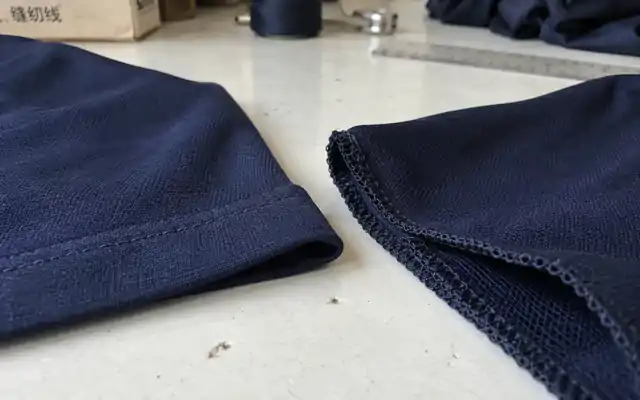
- Waistbands, cuffs and silicone hem grippers add their own pressure; check that they do not roll or dig in during movement.
- Judge the gusset and crotch seams in a deep squat, not standing still.
How should a compression style be fit-tested and approved?
Approve on several bodies across the size range, in movement and after washing, against measured girths rather than one wearer’s impression. A workable sequence:
- Record each fit model’s girths at the reference points beside the size worn.
- Try the base size plus the smallest and largest, on wearers near both ends of each size’s girth range.
- Check squats, lunges and overhead reaches for ride-up, roll-down, seam lines, opacity and grin-through.
- Before publishing a pressure figure, measure it with a calibrated interface-pressure sensor at named points and sizes.
- Repeat the key checks after the agreed washes, then seal the approved sample with its fabric force data.
Which product claims change the evidence a brand needs?
Describing a close, firm fit is a product description. Claiming a health or performance effect needs substantiation, and claiming a medical purpose can make the garment a medical device.
In the US, 21 CFR 880.5780 classifies an elastic stocking that applies controlled pressure to the leg to prevent pooling of blood as a Class II medical device, and one intended for other medical purposes as Class I. Under the EU Medical Device Regulation (EU) 2017/745, device status follows intended purpose, which Article 2(12) reads from labels, instructions and promotional or sales materials. In 2015 Tommie Copper agreed to pay $1.35 million to settle FTC charges over allegedly misleading pain-relief claims for its copper-infused compression wear; the FTC’s guidance that followed names apparel among products whose health claims need competent and reliable scientific evidence, and warns that customer testimonials can carry claims too.
| Claim wording | What it signals | Before using it |
|---|---|---|
| Firm, close fit | Fit and handle | Approved sample and fabric data |
| Graduated compression, stated in mmHg | Measured pressure | Documented method on named sizes |
| Faster recovery, less muscle soreness | Health or performance benefit | Product-specific evidence and legal review |
| Improves circulation, reduces swelling | Medical purpose | Medical-device rules in each market |
Continue your buyer research
Connect this decision to the relevant product, factory process and frequently asked questions before requesting a quotation.
Frequently asked questions
Is there a standard pressure for sports compression wear?
No standard sets a required pressure for sportswear. Medical hosiery is classed in mmHg under national schemes that do not even agree: class 1 is 14–17 mmHg under the British BS 6612 but 18–21 mmHg under the German RAL-GZ 387/1. If you quote a figure, state the size, body point and measuring method, and expect it to be read against those medical classes.
Can a fitted performance tee be sold as a compression top?
Only if it actually compresses. Many fitted tees are cut close to body size with little or no negative ease, so they stay in place without exerting meaningful pressure; fitted or second-skin describes that honestly. If a range is sold as compression, approve it against a pressure or fabric-force target on several sizes, not on appearance.
How many washes should a compression fabric be tested for?
There is no universal count; ASTM D4964 leaves washing and drying cycles to agreement. Choose a number that reflects the product’s expected life and care label, name the procedure, for example one from ISO 6330, and compare force at the same extensions before and after. Lost power and growth in length are the changes to watch.
What is grin-through, and how can a buyer catch it?
Grin-through is pale elastane showing through a dark shade when the fabric stretches. How much shows depends on the knit structure, how the elastane is covered and how evenly the dye reaches both fibres. Stretch lab dips and samples to the worn extension under bright light, on every dark colour, as part of colour approval.
Should compression sizes be based on body or garment measurements?
Publish body measurements and control garment measurements. Pressure depends on body girth relative to the garment, so customers need girth ranges to choose a size, while the factory works to garment measurements and tolerances. Narrow body ranges per size keep pressure consistent; wide ranges mean wearers at the top of a size feel much firmer compression than those at the bottom.
Sources and evidence notes
- Standards publisher: public scopeISO: ISO 20932-1 elasticity of fabrics by strip and loop tests
- Standards publisher: public scopeASTM: D4964 tension and elongation of elastic fabrics
- Official US ruleeCFR: 21 CFR 880.5780, medical support stocking classification
- Official EU regulationEUR-Lex: Medical Device Regulation (EU) 2017/745
- Official US guidanceFTC: five principles for health claims, with the Tommie Copper case