Quick answer
In the US, a hoodie needs its fibre content, country of origin and the responsible business on its labels, plus a permanent care label; brushed cotton fleece is not exempt from testing under the 16 CFR 1610 flammability standard, so the importer should have it tested and support the required certificate. In the EU, the fibre composition must be labelled in the official languages where the garment is sold, and REACH Annex XVII restricts substances such as certain azo dyes, nonylphenol ethoxylates and listed CMR substances in clothing. The importer is responsible; SenLin manufactures to the approved labels and requirements.
The question behind this guide
What rules apply to importing hoodies into the US and EU?
Search suggestions included “are clothing labels required by law”, “oeko tex standard 100”, “does oeko tex allow formaldehyde” and “is recycled polyester clothing safe”. Buyers ask what must go on the label and which chemical or safety checks apply.
Questions were chosen from Google search suggestions checked on 23 September 2026. SenLin’s minimums, sample periods, production periods, sizes and fabric ranges come from its owner-confirmed order terms; technical and regulatory points link to the source they rely on. This is buyer guidance, not legal, customs or testing advice for a specific order.
Key takeaways
- The brand or importer owns compliance; the factory manufactures to it.
- Brushed cotton fleece needs flammability testing for the US.
- Write restricted-substance requirements into the order.
- Label wording must match the approved fabric and care method.
The checklist at a glance
| Requirement | United States | European Union |
|---|---|---|
| Fibre content | Generic fibre names and percentages by weight | Fibre composition with the harmonised fibre names |
| Country of origin | Required on the label | Not required by the textile regulation; any claim must be accurate |
| Business identity | Company name or RN number | Manufacturer and importer contact details under product-safety rules |
| Care instructions | A permanent care label | Not required by the textile regulation; care symbols are widely used |
| Flammability | 16 CFR 1610; brushed cotton fleece is not exempt from testing | Covered by general product-safety obligations |
| Chemicals | Federal and state rules depending on the product | REACH Annex XVII restrictions |
| Language | English | The official languages of each country where the garment is sold |
US labels: fibre, origin, identity and care
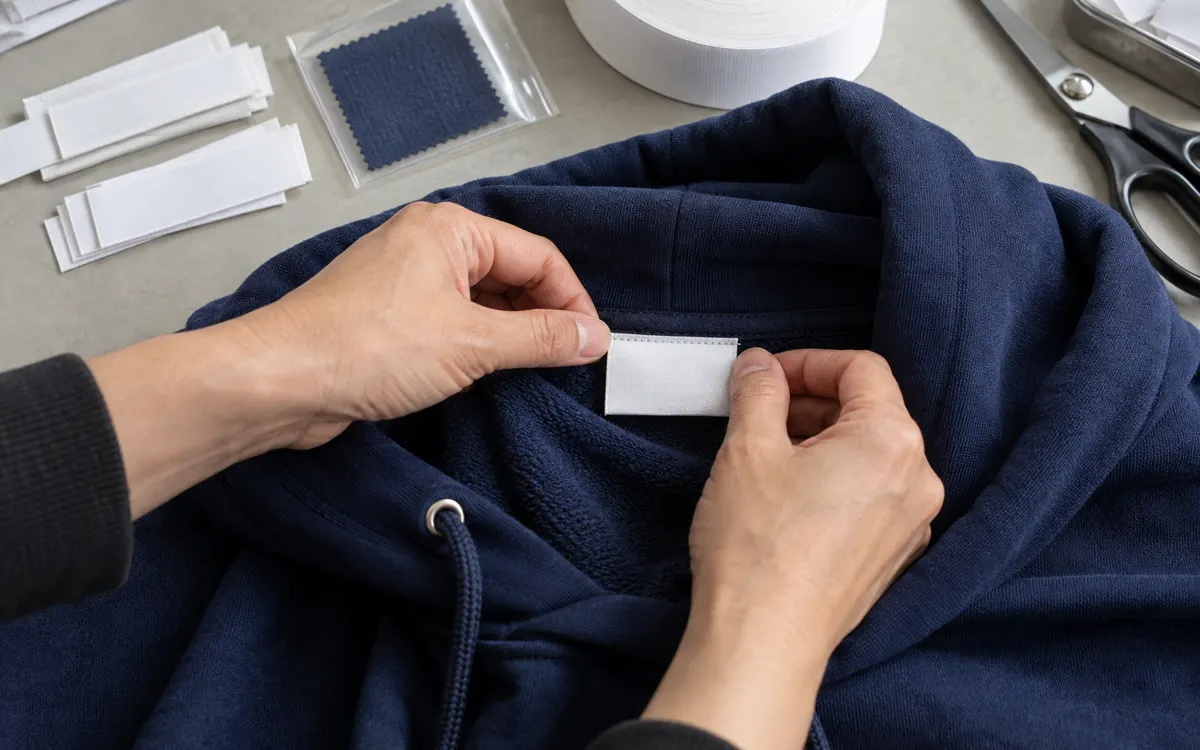
The FTC’s rules under the Textile Act require most textile clothing to show the generic fibre names with percentages by weight, the country of origin, and the name or registered identification number (RN) of the responsible business. The Care Labeling Rule adds a permanent label with instructions for regular care that stays legible for the life of the garment.
The brand or importer decides the wording. The factory sews or prints the labels to the approved artwork, so approve the wording against the final fabric and the tested care method.
US flammability: why cotton fleece matters
Clothing textiles sold in the US must meet the Standard for the Flammability of Clothing Textiles, 16 CFR 1610. Two groups are exempt from testing: plain-surface fabrics of at least 2.6 oz/yd², and fabrics made entirely of acrylic, modacrylic, nylon, olefin, polyester or wool. Brushed cotton or cotton-blend fleece is a raised-surface fabric outside both exemptions, and a blend with any other fibre falls outside the fibre exemption, so the importer should have it tested and support the required certificate.
SenLin’s fleece uses pure cotton, Huamian cotton (华棉) or polyester with 96% or more of the principal fibre, so check the full fibre content of each style against the exemptions.
EU labels and product safety
Every textile product sold in the EU must be labelled or marked with its fibre composition, firmly attached, and translated into the official languages of each country where it is made available to consumers. A garment can be described as “100%”, “pure” or “all” only if it consists of one fibre type.
The textile regulation does not itself require care instructions or a country of origin, but check national rules and make sure any claim you print is accurate. Under the General Product Safety Regulation, the manufacturer’s and importer’s contact details must also accompany the product.
EU chemicals: REACH Annex XVII
REACH Annex XVII restricts hazardous substances in articles placed on the EU market. For clothing, the entries buyers most often specify include azo dyes that can release listed aromatic amines, nonylphenol ethoxylates in textiles that are washed in water, and substances classified as carcinogenic, mutagenic or toxic for reproduction (CMR) in clothing and related accessories. Write the requirements into the order and agree which tests or supplier declarations will support them.
Voluntary certifications are not legal requirements
OEKO-TEX STANDARD 100 tests every thread, button and accessory of a certified article against a list of harmful substances and can support a restricted-substance programme, but it is voluntary and certifies the article or material, not a factory. SenLin does not claim any product certification; if your retailer requires one, name it in the first enquiry and confirm what documentation can be supplied before ordering.
Put compliance into the order
- The destination markets and the label languages they require.
- Fibre content and care wording approved against the final fabric.
- The required tests, their methods and who pays for them.
- The restricted-substance list or standard the goods must meet.
- The documents to deliver with the shipment.
Continue your buyer research
Connect this decision to the relevant product, factory process and frequently asked questions before requesting a quotation.
Frequently asked questions
Is 100% polyester fleece exempt from US flammability testing?
Yes. Fabrics made entirely of polyester—or of acrylic, modacrylic, nylon, olefin or wool—are exempt from testing under 16 CFR 1610. A blend with cotton or another fibre is not covered by that exemption.
Do EU clothing labels need a country of origin?
The EU textile regulation does not require one, but any origin claim you make must be accurate, and national rules or your customers may ask for it.
Who is responsible for compliance?
The brand or importer placing the goods on the market. The factory manufactures to the approved labels, materials and test requirements set out in the order.
Sources and evidence notes
- Official US guidanceFTC: textile fiber, origin and business identity labeling
- Official US guidanceFTC: complying with the Care Labeling Rule
- Official US regulationeCFR: 16 CFR Part 1610, flammability of clothing textiles
- Official EU guidanceYour Europe: textile labels
- Official EU regulationEUR-Lex: General Product Safety Regulation (EU) 2023/988
- Official EU guidanceEuropean Commission: REACH restrictions
- Standard ownerOEKO-TEX: STANDARD 100