Quick answer
For the US, a sportswear garment needs fibre content by generic name and percentage, the country of origin (on the neck label of tops), your business name or RN, and a permanent care label backed by evidence. For the EU, it needs the fibre composition in Annex I names and each sales country’s official language; product-safety rules add manufacturer and importer contact details.
The question behind this guide
What has to be on the label of a private-label sportswear garment sold in the US and EU?
Brands often copy a reference garment’s label, or approve label artwork before the bulk fabric and care method are final, so the fibre names, percentages and care instructions end up describing a different product.
Requirements were read from 16 CFR Parts 303 and 423, Regulation (EU) No 1007/2011 with the European Commission’s FAQ and Your Europe guidance, and the General Product Safety Regulation. This is buyer guidance for knitted sportswear, not legal advice for a specific product or market.
Key takeaways
- Print “elastane”: the EU requires it and US rules accept it, so one composition line can serve both markets.
- Both regimes allow a 3-point manufacturing tolerance on percentages, but neither tolerance rescues a “100%” claim on a blend.
- US tops must show origin on a label at the inside centre neck; the EU textile regulation does not require origin.
- On a US care label, silence is an instruction: omit a bleach warning and the label says any bleach is safe.
What must a sportswear label say in each market?
Fibre composition is required in both markets; the US adds origin, business identity and care. Flammability and chemical rules apply alongside these and are covered in our hoodie import compliance guide.
| Item | United States | European Union |
|---|---|---|
| Fibre content | Generic names and percentages by weight, largest first | Annex I names and percentages by weight, largest first |
| Country of origin | Required, using the English name of the country | Not required by the textile regulation; optional if accurate |
| Business identity | Trading name, registered house-mark trademark or FTC RN | Manufacturer and importer name, postal and electronic address |
| Care | Permanent label with a reasonable basis | No harmonised requirement; ISO 3758 symbols widely used |
| Language | English | Official languages of each country of sale |
| Placement | Origin on a label at the inside centre neck of tops | Durable, legible, visible, accessible and firmly attached |
Spandex or elastane, nylon or polyamide: which name is correct?
Use “elastane”, and either “polyamide” or “nylon”, if one label must serve both markets. US rules at 16 CFR 303.7 establish their own generic names, including spandex and nylon, and also the names in ISO 2076:2013, which include elastane and polyamide. The EU’s Annex I lists “elastane” and “polyamide or nylon”; spandex is not on it. A hypothetical 88/12 tee can read “88% polyester, 12% elastane” in both markets, translated for each EU country of sale.
A fibre trademark cannot replace the generic name. In the US, it must appear in immediate conjunction with the generic name, in lettering of equal size, and a hangtag naming one fibre of a blend must state that it does not give the full fibre content. The Commission’s FAQ confirms that brand names alone do not meet the EU requirement and that additional information must be kept separate.
How precise must the fibre percentages be?
Within three percentage points of the actual content in both markets. Under 16 CFR 303.43, a label stating 40% of a fibre is acceptable if the true figure lies between 37% and 43%, and Article 20(3) of the EU regulation allows the same 3% manufacturing tolerance. A blend cannot be called 100% or pure in either market: the tolerance covers manufacturing variation, not rounding a 96/4 blend up.
Small fibre contents are treated differently. US rules require fibres under 5% to be grouped as “Other Fiber” unless they have a clearly established functional significance; the rule’s own example names 4% spandex, so a small elastane content that provides stretch can be listed. The EU’s general rule is every fibre with its percentage, in descending order.
For garments built from several fabrics, the EU requires the composition of each component, but a component under 30% of the weight need not be listed separately unless it is a main lining; it still counts in the overall figure. US rules allow section-by-section disclosure, require it where needed to avoid deception, exempt trims such as waistbands, cuffs and binding, and let elastic covering up to 20% of the surface be excluded as “exclusive of elastic”.
Where must the label go, and can it be printed?
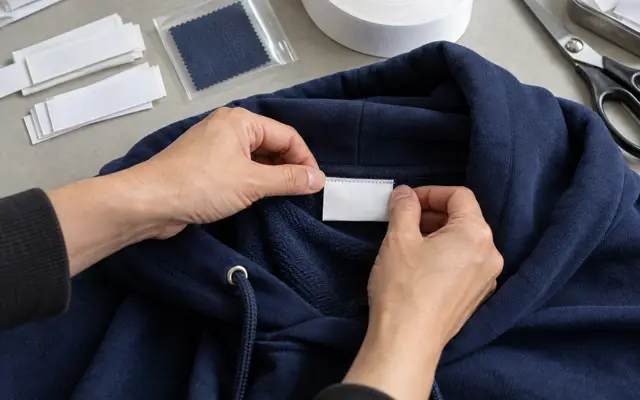
In the US, any top with a neck must disclose origin on the front of a label at the inside centre of the neck, midway between the shoulder seams or close to another label there. Fibre content and identity may share that label or appear on another conspicuous, accessible label, inside or outside the garment.
Printed tagless labels, common in sportswear, are acceptable in both markets if they last: the EU accepts printed or embroidered marking that is durable, legible, visible and accessible, and a US care label must stay legible for the garment’s useful life. Wash a printed neck label through its own care instructions before approving it. A sticker on a sealed polybag does not replace the EU composition label.
Online listings count too. The EU requires fibre composition to be available before purchase, including in distance sales, and US rules treat electronic sales material as mail-order promotion, which must state whether the product was made in the USA, imported, or both.
What care instructions can you justify?
Only those you can support with evidence, and in the US anything the label leaves out is read as permitted. The Care Labeling Rule requires a reasonable basis before sale, such as test results or reliable technical evidence. Its own example: a shirt labelled “Machine wash. Tumble dry. Cool iron.” must withstand hot water, any bleach and a high dryer setting.
Elastane blends and heat-applied logos commonly need cooler washing and drying, no chlorine bleach and a warning against ironing the decoration. Build the instructions from wash tests on bulk fabric with the decoration applied, for example to ISO 6330 domestic washing procedures, and keep the results.
US labels may use ASTM D5489-96c symbols instead of words. The EU has no harmonised care-labelling requirement, but ISO 3758 symbols, revised in 2023, are widely used; make sure symbols and words agree.
Whose name belongs on the label?
In the US, the label carries the name under which a business trades, a US-registered word trademark used as a house mark, or a registered identification number (RN). The FTC issues RNs only to businesses residing in the United States, so a brand based elsewhere uses its trading name or the identification of a US company that markets or handles the goods.
In the EU, the General Product Safety Regulation has applied since 13 December 2024. A brand that sells garments under its own name is the manufacturer: the product must show that name or trademark with a postal and an electronic address, plus a type, batch or serial number, and an importer must add its own details. If the garment cannot carry it, packaging or an accompanying document may. An economic operator established in the EU must also be responsible for the product.
What should you send the factory before labels are made?
Send one label brief per style and market, approved before anything is printed; treat its content as data, not artwork to tidy up later. SenLin manufactures to the label artwork you approve and supplies custom individual packaging and cartons; the wording, and the decision about which tests support it, stay with the brand or importer. Any laboratory testing is agreed per order, and SenLin makes no product certification claims.
- Fibre composition per component, with the bulk fabric specification or test report behind it.
- Markets and languages, with the exact text for origin, identity and GPSR details.
- Care wording and symbols, with their supporting evidence.
- Label type, size, position and attachment: woven, printed satin or heat transfer.
- A batch or style reference that matches the purchase order.
- A signed proof, and a sewn or printed sample approved before bulk.
Continue your buyer research
Connect this decision to the relevant product, factory process and frequently asked questions before requesting a quotation.
Frequently asked questions
Where does the origin label go on shorts and leggings?
Bottoms have no neck, so the US neck-label rule does not apply. The required information, including origin, goes on a conspicuous and readily accessible label inside or outside the garment, with the origin on the front of that label. Waistband labels are common; for the EU, the composition label must be durable, legible, visible and accessible.
Can one label work for both the US and the EU?
Often, yes. Use fibre names valid in both, such as polyester and elastane, place the origin label at the centre neck for the US, give the composition in every required EU language and add the GPSR contact details. Multilingual labels are permitted under the EU rules, although a long list of languages can outgrow a single neck label.
Do corporate uniforms and teamwear need fibre labels?
In the EU, yes: the Commission’s FAQ says garments supplied to corporate purchasers need fibre composition whenever they are made available on the market, even free of charge; commercial documents replace labels only between businesses within the supply chain. The US Care Labeling Rule does not require care information on products sold to institutional buyers for commercial use.
Can I add “recycled” to the composition?
Yes, if it is true and you can prove it. The Commission’s FAQ says the fibre must still be named from Annex I, with a recycled claim shown separately, for example “polyester – recycled fibres”. US rules allow a truthful descriptive term next to the generic name. In both markets, keep the chain-of-custody evidence for the claim on file.
What happens if the bulk fabric differs from the label?
If the measured composition falls outside the three-point tolerance, the garments risk being treated as mislabelled and should be relabelled before sale. Confirm the bulk fabric’s composition before printing labels, check again after any fabric substitution, and keep the mill’s specification or a fibre analysis with the order record.
Sources and evidence notes
- Official US guidanceFTC: US textile and wool labeling requirements
- Official US ruleFTC: Care Labeling Rule
- Official EU regulationEUR-Lex: Regulation (EU) No 1007/2011 on textile fibre names and labelling
- Official EU guidanceEuropean Commission: textile fiber labeling FAQ
- Official EU regulationEUR-Lex: General Product Safety Regulation (EU) 2023/988