Quick answer
Choose French terry for lighter, more breathable hoodies and sweatpants for spring, summer and layering; choose brushed fleece when warmth and a soft, raised inside matter most. Both are knitted sweatshirt fabrics with a smooth face—the difference is the inside: French terry keeps its loops, while fleece has them brushed into a pile that traps warm air. SenLin’s confirmed fleece range covers 200–450 g/m² in cotton or polyester, and the final choice is approved on a physical swatch.
The question behind this guide
Should a hoodie or sweatpants line use French terry or fleece?
Search suggestions repeatedly paired the two fabrics: “french terry vs fleece hoodie”, “french terry vs fleece sweatpants”, “french terry vs fleece warmth” and “is french terry or fleece more expensive”. Buyers ask about warmth, season and cost more than about definitions.
Read the community discussionQuestions were chosen from Google search suggestions checked on 23 September 2026. SenLin’s minimums, sample periods, production periods, sizes and fabric ranges come from its owner-confirmed order terms; technical and regulatory points link to the source they rely on. This is buyer guidance, not legal, customs or testing advice for a specific order.
Key takeaways
- French terry keeps loops inside; fleece brushes them into a warmer pile.
- Compare both at the same finished GSM, fibre and colour.
- Season and silhouette usually decide the choice more than a headline weight.
- Write the inside finish on the specification, not only the fabric name.
French terry and fleece compared
Read the table as tendencies. Yarn, fibre, knit density, brushing depth and finishing move the result, so two fabrics sold under the same name can behave differently.
| Question | French terry | Brushed fleece |
|---|---|---|
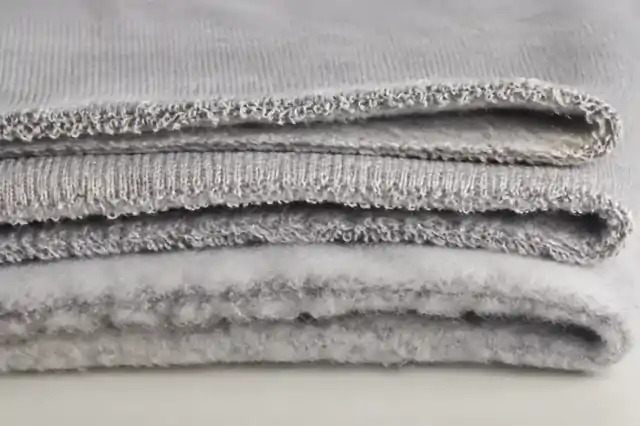
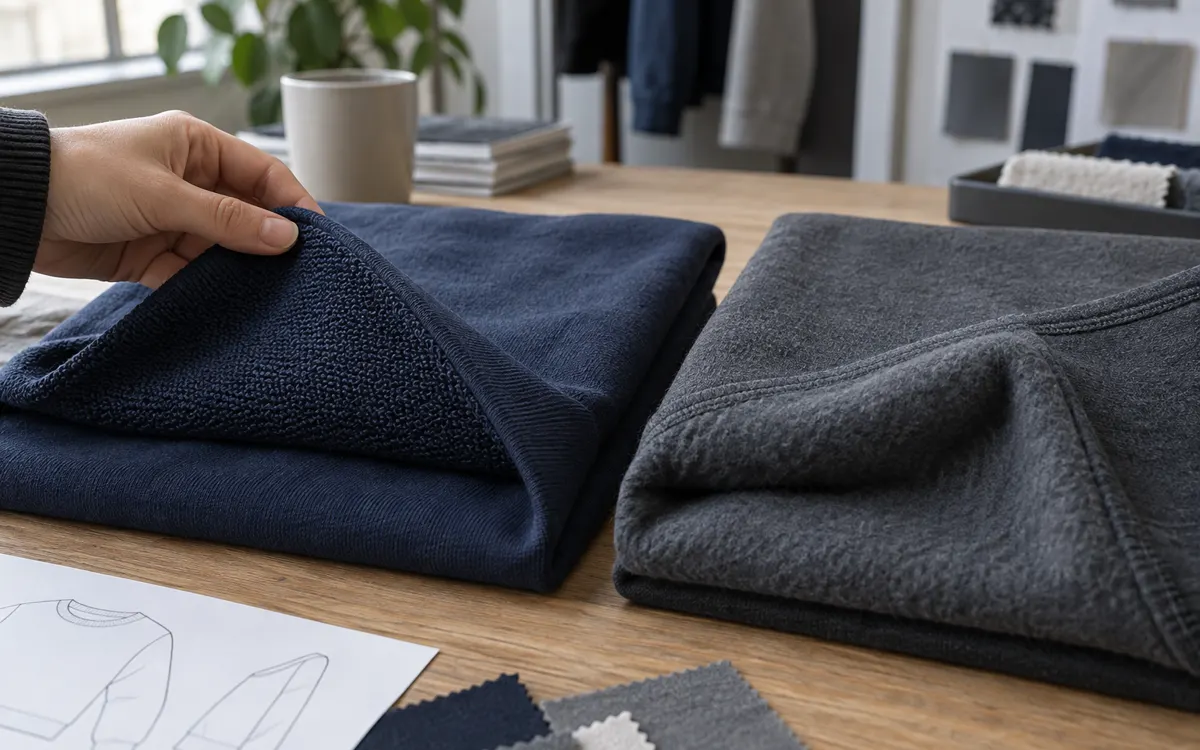
| Inside surface | Small, uncut loops | Loops brushed into a soft, raised pile |
| Warmth | Lighter; traps less air | Warmer; the pile traps air |
| Breathability | Higher | Lower |
| Typical season | Spring, summer, layering and warm climates | Autumn, winter and cold climates |
| Inside handfeel | Textured and dry | Soft and fuzzy |
| Watch-outs | Loops can snag; can look thin at low weights | Pile can shed lint and pill with abrasion |
How the two fabrics are made
Sweatshirt fabrics are commonly knitted with a smooth face and extra yarn carried on the back as loops. Leave the loops intact and the fabric is French terry, also called loopback. Brush the loops and they open into a raised pile: that is fleece. Because the base construction is related, a mill can often offer both from a similar yarn set, which makes side-by-side swatch comparisons practical.
Choose by season, use and silhouette
SenLin’s confirmed fleece range covers 200–450 g/m² (heavyweight hoodies 350–450 g/m²) with summer, spring and all-season options in pure cotton, Huamian cotton (华棉) or polyester, each with 96% or more of the selected principal fibre. Where a style sits in that range is confirmed with the swatch and the quotation.
| Use | Starting direction | Why |
|---|---|---|
| Summer or warm-climate hoodie | Lighter French terry | Breathes and layers without bulk |
| All-season core hoodie | Either fabric at a mid weight | Decide on handfeel and how the hood and body hang |
| Winter or outdoor-team hoodie | Heavier brushed fleece | Warmer inside and more structure |
| Joggers and sweatpants | French terry for movement; fleece for warmth | Leg drape and heat matter more than hood shape |
| Matching hoodie sets | The same fabric family for top and bottom | Shade and handfeel read as one set |
GSM is not the whole answer
GSM measures mass per square metre, not warmth. A brushed fleece can feel warmer than a French terry of the same weight because of its pile, while a dense French terry can look more refined on the outside. Compare swatches at the same finished weight, fibre and colour, and write the finished GSM with a tolerance on the specification.
As a starting point for hoodies, around 200–280 g/m² suits spring and summer, around 300–350 g/m² is a versatile all-season weight, and 380–400 g/m² gives a warmer, more structured winter hoodie.
Decoration and washing on each fabric
Both fabrics are decorated on their smooth face. Check the inside of a decorated sample for comfort where embroidery backing or a transfer sits, and wash-test it, because heat-applied transfers and puff inks can behave differently on a looped back than on a brushed one. Shrinkage and pilling should be agreed as measured limits with a named test method, not assumed from the fabric name.
What to put in the specification
- Fabric type and inside finish: French terry (loopback) or brushed fleece.
- Fibre composition and finished GSM with a tolerance.
- Rib, drawcord and pocketing fabrics, approved to the same colour standard.
- Dimensional change after the agreed wash method, and a pilling assessment if required.
- Care-label wording that matches the approved fabric.
SenLin order baselines for fleece
Ready-stock SenLin hoodies, sweatpants, hoodie sets and fleece layers start at 100 pieces with a logo and mixed sizes from S to 5XL, are supplied without hangtags, and are produced in 15 working days. Custom fleece—your own fabric, colour, fit or construction—starts at 300–500+ pieces and is produced in 20–25 working days. Standard samples take 3–4 days and custom samples 3–7 days; the garment measurement tolerance on confirmed fleece styles is 1–3 cm.
Continue your buyer research
Connect this decision to the relevant product, factory process and frequently asked questions before requesting a quotation.
Frequently asked questions
Is French terry warmer than fleece?
No. At a similar weight, brushed fleece is usually warmer because its raised pile traps more air. French terry is the lighter, more breathable choice for spring, summer and layering.
Is French terry or fleece more expensive?
Neither is always more expensive. Weight, yarn and fibre drive the price more than the name; brushing adds a finishing step, but a heavy French terry can cost more than a light fleece. Compare quotations at the same GSM and composition.
Which is better for sweatpants?
French terry suits joggers for movement and warmer weather; brushed fleece suits cold-weather sweatpants. For matching sets, keep the hoodie and sweatpants in the same fabric family so shade and handfeel match.
Sources and evidence notes
Community sources document recurring buyer questions and experience; they are not treated as universal technical standards. Official guidance is identified separately.
- Community discussionReddit: French terry versus fleece in a sample brief
- Textile industry educationCottonWorks: fleece and French terry material examples
- Standards publisher: public scopeASTM D3776: mass per unit area of fabric