Quick answer
Seams open during exercise when the thread cannot stretch as far as the fabric, when stitches unravel, or when needles have damaged the knit. Prevent it by specifying stitch type, thread, stitch density and needle for each seam, testing that combination on the approved sample, with grab tests for woven seams and burst or extension checks for knits, and rechecking the same seams during bulk inspection.
The question behind this guide
How do I stop activewear seams splitting during workouts?
Buyers often check fabric stretch and assume the seams will follow, or ask for a seam strength test without naming the method, specimen or acceptable result. Stretch seams usually fail at the thread, the stitch ends or the needle holes, which a fabric test never sees.
Prepared from the published scopes of ISO 13935-2, ISO 13938-2, ASTM D1683 and ISO 2859-1, an inspection provider’s service description and common factory practice for stretch seams. It explains how to build a test plan; it does not set pass values or report results for any garment.
Key takeaways
- Stretch seams typically fail through cracked thread, runback, needle damage or escaped edges, so test the seam, not just the fabric.
- ISO 13935-2 grab tests suit straight woven seams; knitted seams need a burst or extension method agreed in writing.
- Test-method standards say how to measure, not what to accept; set each seam requirement in the purchase order.
- Recheck seams inline and at final inspection against the sealed sample, and keep reports with the approval record.
Why do activewear seams open during exercise?
Because a moving body stretches seams further and more often than a hand check suggests, and the weakest element gives first. On stretch garments that is usually the thread, the stitch formation or the needle holes, not the fabric between them.
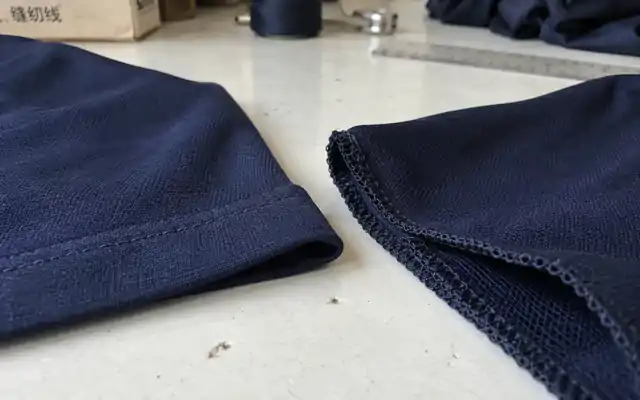
A seam that passes a strength test can still crack in wear if it cannot extend far enough, so a useful test plan covers both force and stretch. These are the failures to design out:
| Failure | What you see | Usual causes | First check |
|---|---|---|---|
| Cracking | Broken thread along a stretched seam | Seam extends less than the fabric; tight tension; low-stretch thread | Stretch to wear extension and look for breaks |
| Runback | Stitching unravels from one broken point | Chain stitch or thread ends not secured | Pull a cut end; check how seam ends are locked |
| Needle damage | Pinholes beside the stitch line that ladder | Wrong needle point, blunt needle, excessive stitch density | Inspect stretched seams before and after washing |
| Edge escape | Fabric edge pulls out of the stitch | Edge trimmed too close or not caught; yarn slippage on wovens | Inspect the inside; slippage test for wovens |
| Skipped stitches | Gaps or irregular loops | Machine timing, needle or thread choice, fabric lifting with the needle | Stretch the full seam length under good light |
Which seam tests suit knitted and woven activewear?
Match the method to the fabric: seam-force tests for wovens, burst or extension methods for knits, and wear and wash trials for both.
ISO 13935-2 measures the maximum force to seam rupture by the grab method, with the force applied across the seam; ISO 13935-1 does the same on a strip specimen. Both are designed mainly for woven fabrics, including stretch wovens, and apply to straight seams only. ASTM D1683 covers sewn seams in woven apparel fabrics and states that it does not predict how a seam performs in wear. Yarn slippage at seams in wovens has its own series, ISO 13936.
Knits stretch in every direction, so a grab test tells you little about them. ISO 13938-2 measures bursting strength and distension by air pressure and applies to knitted fabrics; laboratories often place a seam across the test area to compare seam and fabric bursts. That is an agreed adaptation rather than a seam procedure written into the standard, so specify the seam position, test area and specimen source. For stretch seams, add an extension check: stretch the seam to a stated extension or load, release it and record any broken stitches.
| Method | Measures | Suits | Limits |
|---|---|---|---|
| ISO 13935-2 grab | Force to seam rupture | Woven and stretch-woven seams | Straight seams only |
| ISO 13935-1 strip | Force to seam rupture | Woven seams | Straight seams only |
| ASTM D1683 | Seam rupture or slippage | Woven apparel seams | Does not predict wear |
| ISO 13938-2 burst | Burst pressure and distension | Knits; seams by agreement | Seam set-up must be specified |
| Extension check | Broken stitches at a set stretch | Stretch knit seams | Define it in writing |
| Wear and wash trial | Comfort, cracking, appearance | All activewear | Record conditions and findings |
What should a seam requirement state?
Enough that two factories would sew the same seam and two laboratories would test it the same way. Test-method standards describe how to measure, not what result to accept; requirement values come from your own product history, a retailer manual or your laboratory’s advice. For each critical seam, state:
- Location and operation, such as side seam, inside leg or crotch junction.
- Stitch type by ISO 4915 number and seam type, with the number of needles.
- Thread fibre, construction and size for needle and looper positions.
- Stitch density per centimetre, with a tolerance.
- Needle size and point; light or medium ball points are common on fine knits.
- Seam allowance or trimmed width, and bartacks where seams cross under load.
- Test method and edition, specimen source, conditioning, number of specimens, requirement and who tests.
How should seams be approved at sample stage?
Test the approved fabric, thread and machine set-up together, on the sample that will be sealed as the bulk reference; changing any of them later reopens the question.
With SenLin, seam tests, inspection scope and any certificates are agreed per order, and SenLin publishes no in-house lab results, so name the method, laboratory and requirement in the purchase order. Custom samples take 3–7 days and standard-style samples 3–4 days, which leaves time to sew and stretch-check seam variants before approval. A practical sequence:
- Test the fabric alone first, so each seam result has a baseline.
- Sew test seams on the machine type, thread and density planned for bulk.
- Run the agreed laboratory method and the extension check.
- Wear-test the movements the product is sold for: squats, lunges, sprints and overhead reaches.
- Wash to the care label for the agreed cycles, then recheck cracking, needle holes and puckering.
- Seal the sample and attach the seam list and reports to the approval record.
How do you keep bulk seams matching the approved sample?
Check seams while production runs and again at final inspection, against the sealed sample and the written seam list.
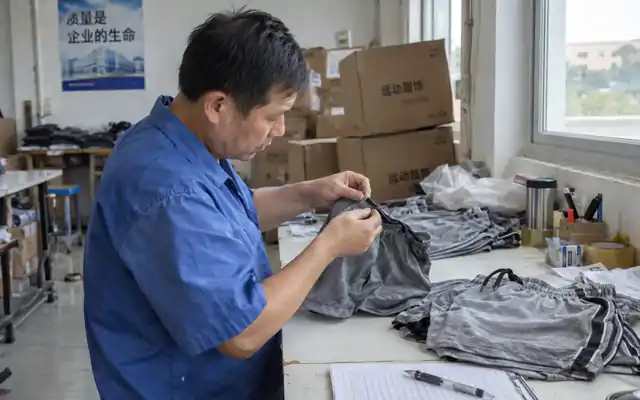
Inline checks catch set-up drift early: count stitches per centimetre, stretch-check the first pieces from each machine, and look for needle holes after needle changes. A final random inspection then samples the finished lot. SGS, for example, describes inspecting when production is complete and 80–100% export-packed, against the reference sample, specification and purchase order.
Sampling plans come from ISO 2859-1 or its US counterpart, ANSI/ASQ Z1.4. The AQL, and whether an open or cracked seam counts as a major or critical defect, are for buyer and supplier to agree. SenLin publishes no AQL level; it keeps a bulk inspection record, which should show seam findings against the agreed list.
What evidence should a buyer keep?
A seam dispute is settled by records, not memories. Keep these together for each style and lot, filed with the approval rather than in a separate folder:
- The sealed sample and the seam list it was approved against.
- Laboratory reports showing method, edition, specimen source and results.
- Wear-trial and wash-trial notes with dates and the sample version.
- Inline check sheets and the final inspection report, with photographs of seam defects.
- Corrective actions agreed after any failure, and evidence that they were applied.
Continue your buyer research
Connect this decision to the relevant product, factory process and frequently asked questions before requesting a quotation.
Frequently asked questions
Is a higher stitch density always stronger?
Only up to a point. More stitches per centimetre spread the load and usually let a seam extend further, but every extra needle penetration weakens a fine knit and can cause puckering or needle damage. Specify a density range for each operation, test seams at both ends of that range, and keep the approved figure on the specification sheet.
Which thread suits stretch seams?
Commonly a strong core-spun or filament polyester in the needles and a softer textured polyester or nylon in the loopers, which carry most of the thread in overlock and cover stitches and sit against the skin. The right choice depends on stitch type, fabric and dyeing, so name fibre, construction and size for each position and test the combination, not the thread alone.
What is seam efficiency?
Seam efficiency compares a seam with the fabric it joins: seam strength divided by fabric strength, expressed as a percentage and measured by the same method. A low figure shows that the seam is the weak link even when the fabric performs well. It is useful for comparing seam options during development, but it is not a pass value unless buyer and supplier agree one.
Why can seams pass at sample stage and fail after washing?
Washing and wear add abrasion, heat and repeated stretching. Elastane can lose power, threads abrade, small needle holes can run into ladders, and shrinkage changes seam tension. A sample tested only when new misses all of this, so repeat the extension check and a visual seam review after the agreed number of wash cycles, using the care-label conditions.
Do seam tests need an accredited laboratory?
For screening during development, a consistent in-house extension check is quick and useful. For results that decide acceptance, use a laboratory accredited to ISO/IEC 17025 for that specific method, and agree beforehand who pays and what happens after a failure. Ask every report to state the method edition, specimen source and conditioning, so results from different laboratories can be compared.
Sources and evidence notes
- Standards publisher: public scopeISO: ISO 13935-2 seam maximum force by the grab method
- Standards publisher: public scopeISO: ISO 13938-2 bursting strength and distension, pneumatic method
- Standards publisher: public scopeASTM: D1683 failure in sewn seams of woven fabrics
- Standards publisher: public scopeISO: ISO 2859-1 sampling by attributes indexed by AQL
- Inspection provider: service scopeSGS: final random inspection against agreed specifications