Quick answer
No. An AQL inspection examines a random sample, not every garment. Under ISO 2859-1 normal single sampling, a 2,000-piece lot inspected at general level II gives a sample of 125, and at AQL 2.5 the lot passes with up to seven defective garments. A lot that is 5% defective still passes about seven times in ten. Treat a pass as evidence about the lot, not a guarantee.
The question behind this guide
Does passing an AQL inspection mean every garment in my order is good?
Buyers often read “AQL 2.5” as a promise that no more than 2.5% of the order is faulty, then book an inspector without defining the lot, the defect classes or what happens after a failure.
Sample sizes and acceptance numbers come from the ISO 2859-1 single-sampling tables for normal inspection; ISO lists skip-lot procedures and curve methods as the main changes in the 2026 edition. Pass probabilities are our own hypergeometric calculations, and inspection timing follows SGS’s published service scope. This is not a SenLin inspection policy.
Key takeaways
- An AQL is the worst process average the sampling scheme tolerates, not a cap on faulty garments in your shipment.
- Sample size follows lot size and inspection level; general level II applies unless the contract specifies another.
- Agree the lot, defect classes, tolerances, reference sample and failed-lot remedy in writing before the inspector arrives.
- A random inspection cannot show wash fastness, shrinkage or fibre content; those need laboratory reports on bulk materials.
What does AQL 2.5 actually mean?
It means the sampling scheme is designed to accept most lots from a process averaging 2.5% defective or better. ISO 2859-1 defines the acceptance quality limit as the worst tolerable process average when a continuing series of lots is submitted for sampling. It is a parameter of the plan, not the largest share of faulty garments your shipment may contain.
The standard itself notes that a lot as bad as the AQL can still be accepted with fairly high probability, and cautions that naming an AQL does not entitle a supplier to ship nonconforming items knowingly. ISO published the third edition, ISO 2859-1:2026, in January 2026. Many inspection firms work from the US counterpart, ANSI/ASQ Z1.4; SGS states that its final random inspections sample to Z1.4. Name the standard and edition in your order.
The scheme also assumes a continuing series of lots, with switching rules that tighten inspection when results deteriorate. A single first order never gives those rules a chance to work. For isolated lots, ISO 2859-2:2020 offers plans indexed by limiting quality instead.
How many garments will the inspector check?
For lots of 91 to 10,000 pieces at the default level, between 20 and 200 garments, set by the lot size and the inspection level. ISO 2859-1 uses general level II unless something else is specified; level III draws larger samples and level I smaller ones. The figures below are single sampling plans for normal inspection at level II. A lot fails as soon as the count of defective garments exceeds the pass figure.
The standard explains that the information a sample gives depends on its absolute size, not on its share of the lot. Twenty garments are a fifth of a 100-piece order, yet by our calculation a 100-piece lot that is 10% defective passes its plan about 36% of the time, while a 2,000-piece lot at the same defect rate passes the 125-piece plan only about 5% of the time.
| Lot size (pieces) | Code letter | Garments sampled | Pass at AQL 2.5 | Pass at AQL 4.0 |
|---|---|---|---|---|
| 91–150 | F | 20 | Up to 1 defective | Up to 2 defective |
| 281–500 | H | 50 | Up to 3 | Up to 5 |
| 501–1,200 | J | 80 | Up to 5 | Up to 7 |
| 1,201–3,200 | K | 125 | Up to 7 | Up to 10 |
| 3,201–10,000 | L | 200 | Up to 10 | Up to 14 |
What can a passed inspection not tell you?
It cannot vouch for the garments nobody opened, and it cannot see properties that only appear after washing or testing. Take a hypothetical lot of 2,000 tops containing 100 defective pieces, or 5%: by our calculation it passes the AQL 2.5 plan above about 72% of the time, and at 8% defective it still passes about one time in five.
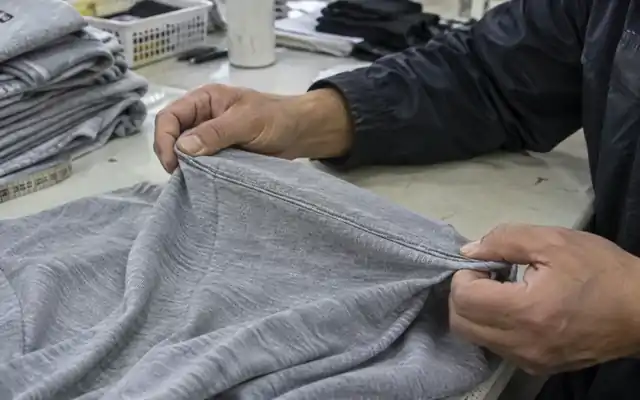
Defects also cluster. One size cut from a faulty marker, one colour dyed off-shade or one operator’s skipped stitches can sit in a few cartons that a purely random draw misses. Ask for the sample to be drawn across every colour, size and carton range in proportion to the order.
On site, an inspector checks appearance, workmanship, measurements, quantities, labels and packing. Colour fastness to washing (ISO 105-C06), dimensional change after laundering by ISO 6330 procedures, pilling, fibre composition and restricted substances need laboratory reports on the bulk fabric, agreed before production starts.
Which activewear defects are critical, major or minor?
Critical defects make a garment unsafe or unlawful to sell, major defects make it unsaleable or likely to be returned, and minor defects are cosmetic. Define each class in the inspection protocol, not on the factory floor. ISO 2859-1 leaves the AQL to the contract; many apparel buyers accept no critical defects and set AQL 2.5 for major and 4.0 for minor defects, a convention rather than a requirement of the standard. The examples below are a typical starting point for knitted performance wear.
| Class | Activewear examples | Usual treatment |
|---|---|---|
| Critical | Broken needle or other sharp metal; missing or wrong mandatory fibre, origin or care label | None accepted; the lot is held |
| Major | Open or cracked stretch seam, hole, panel shade mismatch, logo outside placement tolerance, measurement out of tolerance | Counted against the major AQL |
| Minor | Untrimmed thread, slight puckering, removable mark, crooked hangtag | Counted against the minor AQL |
What should the inspection protocol say before you book?
It should define the lot, the sampling plan, the references, the product-specific checks, the packing requirements and what happens after the result. SGS describes final random inspection as an on-site check made when production is complete and 80–100% export packed, against the reference sample, confirmed specification, purchase order and packing instructions. Each of those references has to exist in writing before the inspector arrives.
SenLin’s published measurement tolerance is 1–2 cm for performance tees, shorts and pants and 1–3 cm for fleece styles such as sweatpants and midlayers, which gives an inspector a written limit rather than a judgement call. SenLin provides a bulk inspection record; any third-party inspection, its scope and the AQL are agreed per order, and SenLin does not publish an AQL level.
- Lot: style, colours and quantity, and whether several styles count as one lot.
- Sampling: standard and edition, inspection level, AQL for each defect class, and a draw across colours and sizes.
- References: approved sample code, specification revision, measurement chart with tolerances, artwork and label approvals.
- Activewear checks: seams stretched by hand, shade match within sets, heat-transfer and reflective trim adhesion, waistbands relaxed and extended.
- Packing: carton count, size ratio, carton marks, barcodes and polybag requirements.
- Outcome: who receives the report, who may release goods marked for the client’s decision, and who pays for re-inspection.
What happens when a lot fails?
A failed lot should be sorted, not patched. ISO 2859-1 says a non-accepted lot is not resubmitted until every item has been re-examined and nonconforming items removed, replaced or corrected. The responsible authority then decides whether re-inspection is normal or tightened, and whether it covers every defect class or only those that caused the failure.
Replacing only the garments the inspector found leaves the rest of the lot unchanged, because the sample stood in for the whole order. Agree three outcomes in advance: sort and re-inspect, accept with a written concession, or reject. Keep the report, photographs and sampling plan with the purchase order; they are your evidence for any later claim.
Continue your buyer research
Connect this decision to the relevant product, factory process and frequently asked questions before requesting a quotation.
Frequently asked questions
Is AQL 2.5 strict enough for premium activewear?
It is a common level for major defects, but the right level depends on your price point and returns risk. A lower AQL, such as 1.5, accepts fewer defective garments in a sample of the same size. Whatever you choose, pair it with a precise defect list and tolerances; a strict number applied to vague criteria still gives inconsistent results.
Who usually pays for a third-party inspection?
There is no fixed rule. Many buyers pay for the first final inspection and write into the order that the supplier pays for any re-inspection caused by a failure. Agree this before booking, together with the notice the inspector needs and how a failed or pending result affects the shipping date.
Can a factory’s own inspection record replace an independent inspection?
It can, if the record shows the sampling plan, the garments examined, defects found by class, measurements and photographs against your approved references. The difference is independence: a third-party inspector reports to you. Many buyers accept factory records for repeat styles and book independent inspections for first orders or new constructions.
Is it worth inspecting a 100-piece order?
Yes, but know the limits. At general level II, a 100-piece lot gives a 20-garment sample that passes at AQL 2.5 with one defective piece. For small, high-value orders, ask for a price on checking every garment; the sampling table itself switches to 100% inspection whenever the sample would equal or exceed the lot.
When should the final inspection be booked?
Book it for when production is complete and at least 80% of the goods are packed, the point SGS uses for final random inspection. Earlier checks catch problems while they can still be fixed: materials before cutting and the first sewn pieces during production. Leave time before the shipping cut-off for sorting if the lot fails.
Sources and evidence notes
- Standards publisher: public scopeISO: ISO 2859-1:2026 sampling schemes indexed by acceptance quality limit (AQL)
- Standards publisher: public scopeISO: ISO 2859-2:2020 sampling plans indexed by limiting quality for isolated lots
- Inspection provider: service scopeSGS: final random inspection against agreed specifications
- Standards publisher: public scopeISO 105-C06: colour fastness to domestic laundering
- Standards publisher: public scopeISO 6330: domestic washing and drying procedures