Quick answer
Choose the label by its job, then approve the finished construction on the intended garment. A woven label forms its design with yarn; a printed label carries ink on a separate substrate; a heat-transfer mark sits directly on the garment. None is automatically the most comfortable, durable or suitable for every required instruction. Compare a real-size proof, skin contact and repeated care before ordering.
The question behind this guide
How do you choose a label that stays useful after the garment is sold?
The October 2026 OIA Catalyst programme put product longevity on the sourcing agenda. For private-label apparel, one practical question is whether branding and care information remain readable and comfortable through use. The programme is an industry discussion signal, not evidence of a measured change in label demand.
The comparison below is a purchasing framework. The US care-information requirement is linked to the FTC rule; construction choices still need garment-specific approval. It does not establish SenLin availability for every label route.
Key takeaways
- Separate brand identity from required product information.
- Compare finished edges and attachment, not only artwork.
- Approve small text at its final physical size.
- Confirm durability on the garment and under its proposed care procedure.
Separate the branding job from the information job
A prominent brand label and a detailed care label do not have to use the same construction. Start with a list of the information each location must carry: identity, size, fibre content, origin or care. Review the wording for the destination market separately from the choice of material.
Avoid squeezing the whole information set into a small brand tab just to keep the inside clean. Conversely, a decorative hangtag does not settle the question of which information must remain with the garment. For market wording, use the existing sportswear labelling guide.
Compare the three constructions on the finished garment
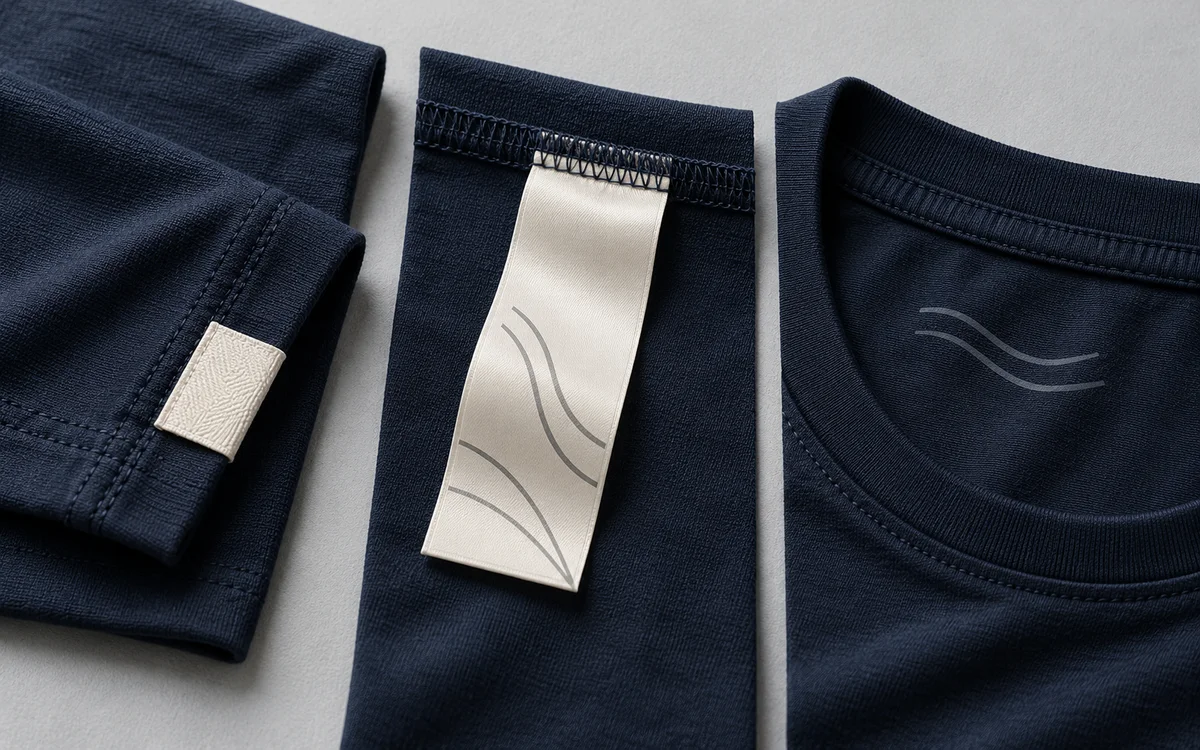
Use these as review questions, not universal performance rankings. A soft sewn label may suit one neckline better than a transfer; another garment may benefit from a direct mark. Request the actual construction and application details from the supplier before comparing offers.
Keep costs and minimums tied to that specification. Artwork, dimensions, quantities, colours, material and attachment can change the quotation. This guide supplies no label prices, minimums or production-time promises.
| Route | What to compare | Approval risk |
|---|---|---|
| Woven sewn-in label | Yarn detail, edge finish, fold and attachment seam | Small lettering or a stiff edge may be unsuitable at the chosen size |
| Printed sewn-in label | Substrate, ink definition, cut edge and folding | Initial clarity alone does not establish lasting readability |
| Direct heat-transfer marking | Mark definition, handfeel, application and fabric compatibility | The mark may behave differently across fabrics, colours and care conditions |
Check readability at real size
Review the physical proof rather than approving an enlarged screen image. Confirm letter spacing, contrast, language versions and the smallest essential text. Inspect the folded and attached version: a seam allowance or fold can hide wording that looked clear in the artwork.
Where several languages or style-specific compositions are needed, map the information versions to their garment references. More space or a separate information label can be preferable to reducing text until it is difficult to read. Ask the buyer to sign off both content and physical layout.
Assess comfort, attachment and stretch together
Place the label on the intended garment and check it in normal wear positions. Examine corners, edges, seam bulk and the contact area behind the neck or at the side seam. For stretch garments, look at how the mark or attachment behaves as the surrounding fabric moves.
A transfer avoids a separate sewn tab, but that does not prove an irritation-free garment. A woven or printed label can also vary substantially with material and finishing. Do not approve comfort from the route name alone.
- Confirm the exact inside location and orientation.
- Check the attachment seam and any backing.
- Review appearance and feel after the agreed care sequence.
- Record any restriction on fabric, colour or placement.
Validate care-information durability separately
For US products covered by the FTC care-labelling rule, required care information must remain attached and legible through the useful life of the product. The rule also requires a reasonable basis for care instructions. Selecting a woven construction or a transfer does not itself prove these conditions are met.
Agree how the supplier will demonstrate the proposed label and attachment remain suitable under the final care instructions. Keep that evidence with the approval record. A short wash check is useful development evidence; it is not automatically a useful-life guarantee.
Approve one complete label specification
Record label reference, artwork revision, finished dimensions, material, colours, folds, attachment, location and approved wording. Link the proof to the garment fabric and care revision. Before bulk, ask whether any change to ink, adhesive, substrate or application settings needs renewed approval.
This framework is for ordinary adult apparel branding and information planning. It is not a complete legal review for every market or a specialist safety-labelling specification. SenLin label construction, supporting evidence, availability and commercial terms must be confirmed for the actual project.
Planning a private-label range? Send your garment reference, label artwork and sales markets to discuss a construction and approval brief. If WhatsApp is easier, you can contact SenLin on +86 15859585198.
| Sign-off item | Evidence to retain |
|---|---|
| Content | Approved market-specific artwork and translation |
| Construction | Physical label and attached garment reference |
| Care review | Agreed procedure, observations and supporting evidence |
| Bulk control | Version identifiers and change-approval responsibility |
Continue your buyer research
Connect this decision to the relevant product, factory process and frequently asked questions before requesting a quotation.
Frequently asked questions
Are woven labels always better than printed labels?
No. Compare the final lettering, edge finish, comfort and attachment for the intended garment. Construction names alone do not determine suitability.
Is a heat-transfer neck mark the same as a care label?
Not necessarily. A neck mark may carry branding or size only. Confirm which required information it carries and whether the final application meets the relevant market requirements.
Can a hangtag replace permanent care information in the US?
For ordinary products covered by the FTC rule, a detachable hangtag alone does not meet the requirement for care information that remains attached and legible. Check any applicable exemption separately.
Should I test the label on every fabric?
Confirm a review scope covering the actual fabric, colour, application and care combinations. Do not assume evidence from a different substrate automatically applies.
What should I send SenLin before requesting a label quotation?
Send the garment reference, sales markets, information and language versions, artwork, preferred location and order quantities. Ask for construction options and evidence before approving the final route.
Sources and evidence notes
- US regulatory text; selected requirements, not a global label checklistFTC — Care Labeling Rule, 16 CFR Part 423
- Industry programme; product longevity context, not demand dataOIA — 2026 Catalyst Conference agenda